Not many people know about the Yazidis — an ancient tribe of Mesopotamia with beliefs and traditions that are part Muslim, part Christian, and a lot their own. I met a few Yazidis when I was in Greece during 2015 when thousands of people were fleeing to Europe from wars in the Middle East. At the time, many Yazidis were escaping persecution by ISIS. I recently visited their most important holy place — Lalish Temple — in northern Kurdistan. Lalish is only a two hour drive from Erbil but, in some ways, it feels like a million miles from anywhere.
The view from Lalish. Notice the flaring gas coming from an extraction facility on the left.
Lalish was built about 4,000 years ago. It sits in a narrow canyon just beyond hillsides of oil and gas extraction facilities — an eerie gateway to the temple grounds. No one except a few caretakers lives in or near Lalish, but on the day I visited, many pilgrims were camping at the temple site for a festival that was to begin the next day. Not many tourists visit Lalish so, as I expected, there weren’t tour guides at the site and almost no one I encountered spoke English. I did a little online research about what I saw and experienced.
The Yazidis believe in one god and are very in tune with the natural world. Hoping to keep their traditions alive, they don’t accept converts or inter-marriage with members of other religions.Arriving at the site, I was asked to remove my shoes and reminded to step over –not on– door thresholds.
Just inside the temple doors, Yazidi pilgrims were tying knots in silk scarves hanging from temple pillars. Each knot represents a prayer. Untying another pilgrim’s knot is believed to grant that person’s wish. Yazidis typically wear red to represent the blood of the many members of the community who have died. Yazidis have been persecuted for hundreds of years.
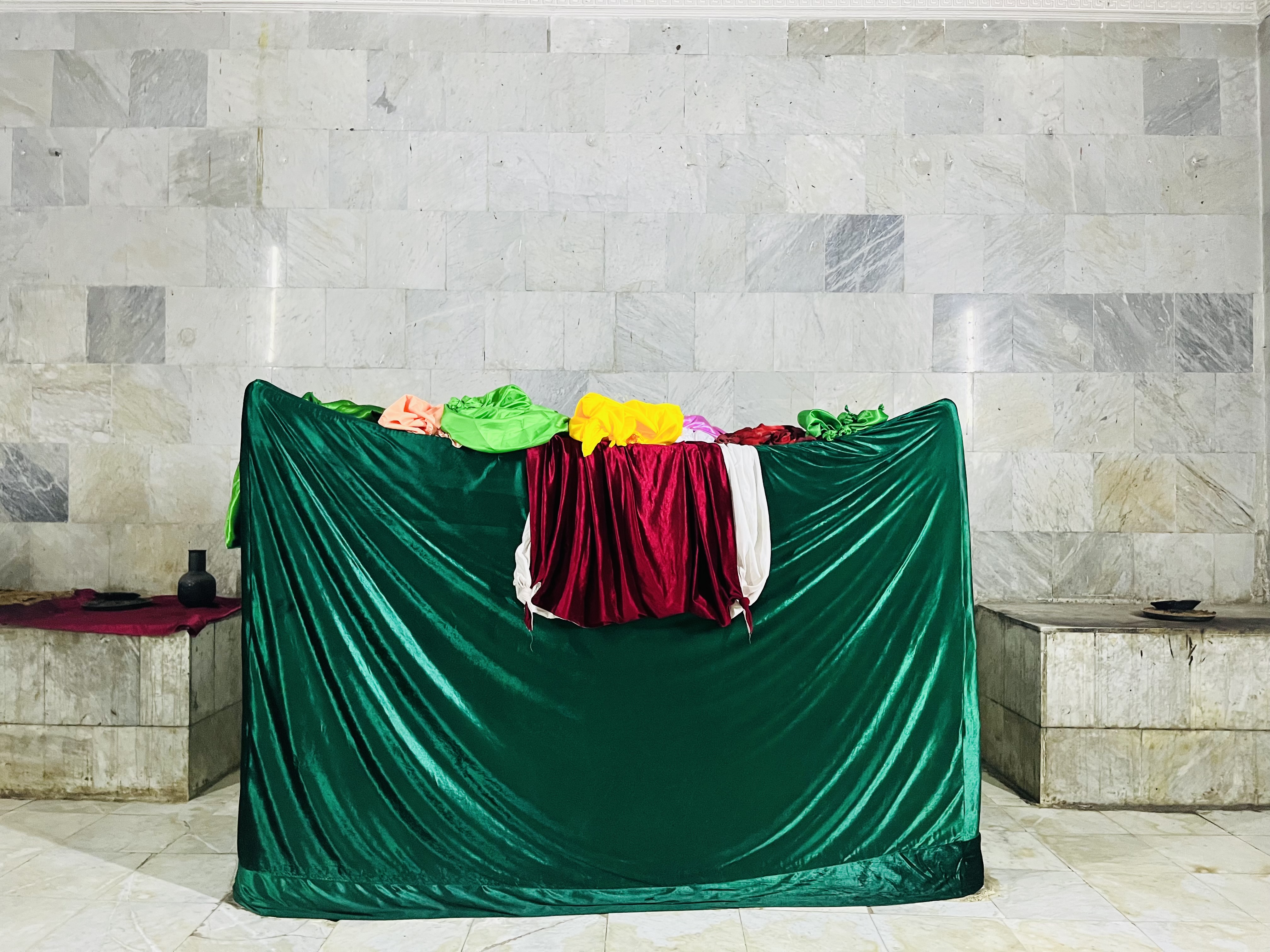
At the temple, Yazidi pilgrims walk three times counter-clockwise around the tomb of Sheikh Adi, a Yazidi saint who lived in the 11th century.He is considered the earthly incarnation of one of the seven divine beings whom god assigned to oversee the world’s affairs.
Inside the temple are several caves. The walls of this one were covered in tar (which seems to be everywhere) and decorated with hand prints. Tar seemed to be dripping from the ceiling because the floor was black and damp. One article I read said the jars are filled with curing olives but these jars seemed to be empty.
In one of the caves, pilgrims –eyes closed — throw heavy scarves toward a rock ledge. If your scarf lands on the ledge within three tries, your wish comes true.My scarf went random other places.
In one of the temple caves is a holy spring. These boys showed me how they kept the cave walls wet by throwing spring water on them. I couldn’t find any information about the significance of this.
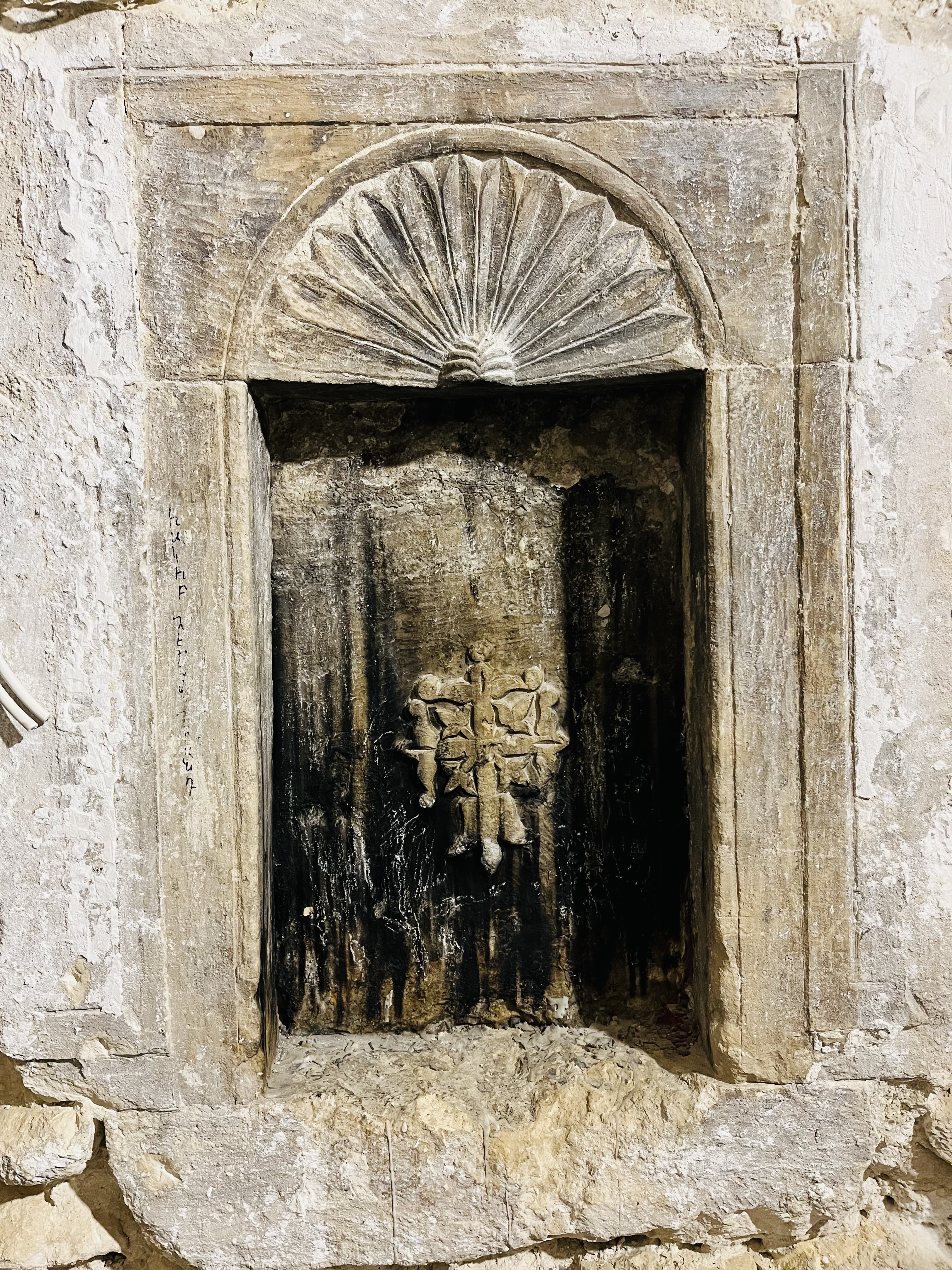
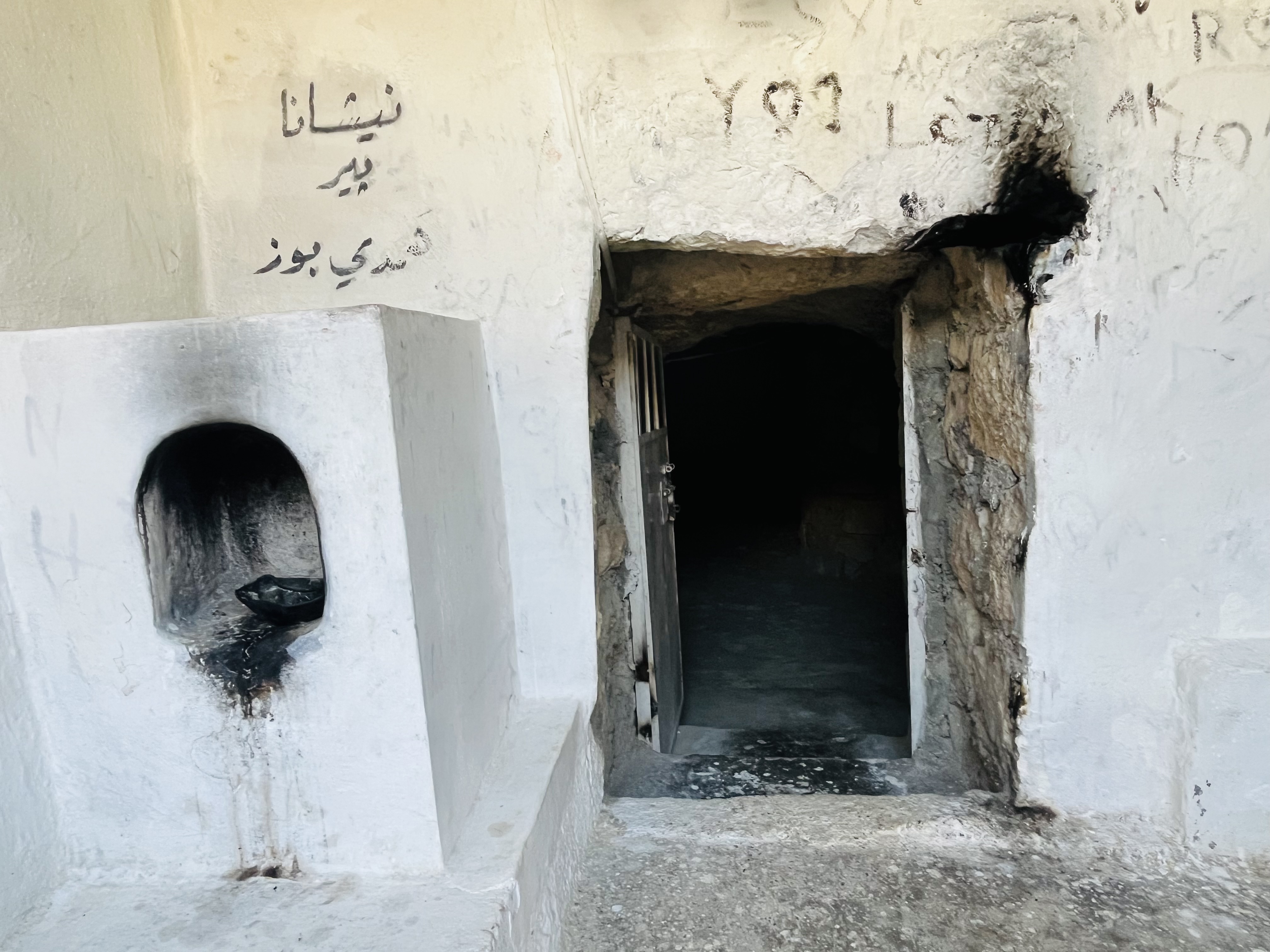
Candlelight and fire are very important in Yazidi ritual. Throughout the temple complex, the walls had places for burning candles and tar.The black tar was also in some unexpected places, like the door jamb.
Walking through the complex, this group of women stopped me to offer me to tea. One of them spoke English and we talked about the temple and their lives. They were so warm and friendly.
Yazidis are a close knit community but welcomed me, and want the outside world to understand them. My day at Lalish didn’t shed much light on the Yazidi’s mysterious traditions and beliefs, but it helped me feel connected to the community. And that’s a lot.
What incredible experience, Kim! How different we humans are and yet so similar. I’d love to know how you manage to get to Lalish. How far from the temple do the people live? Where did you stay? How many Yazidis are there? From your photos, they seem to be so friendly which is surprising after being attacked by the different groups around… So many questions come to mind!
Hi Carolina, I was staying in Erbil, which has lots of hotels, and I hired a taxi for the day to take me to Lalish — was about $70 but about a third of the cost of a private tour guide (and there were no group tours when I was there) I think most Yazidis live in Singar mountain area or Duhok, both of which are probably less than an hour’s drive. There are about a million Yazidis worldwide and maybe 700,000 in northern Iraq. I asked the women about the effects of the violence by ISIS. They said the community is still in trauma — they are a close-knit community so I suspect that helps a little.
I felt very safe in Kurdistan, Iraq — and I was traveling alone. The crime rate is very low and ISIS is pretty much gone. I understand that Federal Iraq (where Baghdad is) is a little riskier, but I would definitely go there and lots of tour groups are traveling there. Of course, the situation in that part of the world is unpredictable right now. I ditched my plan to go to Syria because Israel is bombing the border region.
Very mysterious and interesting. Great pictures (I love the one with you and the women best) and your narrative inspires many questions. I will do some research on this later today. Do you have any recommendations as to websites to check out?







 Camino Milagro
What incredible experience, Kim! How different we humans are and yet so similar. I’d love to know how you manage to get to Lalish. How far from the temple do the people live? Where did you stay? How many Yazidis are there? From your photos, they seem to be so friendly which is surprising after being attacked by the different groups around… So many questions come to mind!
Thanks for sharing!
Hi Carolina, I was staying in Erbil, which has lots of hotels, and I hired a taxi for the day to take me to Lalish — was about $70 but about a third of the cost of a private tour guide (and there were no group tours when I was there) I think most Yazidis live in Singar mountain area or Duhok, both of which are probably less than an hour’s drive. There are about a million Yazidis worldwide and maybe 700,000 in northern Iraq. I asked the women about the effects of the violence by ISIS. They said the community is still in trauma — they are a close-knit community so I suspect that helps a little.
Very interesting, thank you for sharing!
🙂
This is fascinating, I’ve never heard of them. How is it travelling through Iraq right now? Are there safety concerns? Maggie
I felt very safe in Kurdistan, Iraq — and I was traveling alone. The crime rate is very low and ISIS is pretty much gone. I understand that Federal Iraq (where Baghdad is) is a little riskier, but I would definitely go there and lots of tour groups are traveling there. Of course, the situation in that part of the world is unpredictable right now. I ditched my plan to go to Syria because Israel is bombing the border region.
Good to know. Thanks
Very mysterious and interesting. Great pictures (I love the one with you and the women best) and your narrative inspires many questions. I will do some research on this later today. Do you have any recommendations as to websites to check out?
Thanks Kim!
xoxoxo
Thanks for this introduction to the Yazidis. So glad that they welcomed your visit ❤
Thanks Rosaliene!
very interesting, thank you
Thank you for dropping by!