
Pashupatinath is a sacred Shiva Temple in Kathmandu and among the most important pilgrimage places for Hindus. The temple is part of a large complex on the banks of the Bagmati River, which flows into the most sacred river Ganges in India. In the past week, I’ve spent several hours at Pashupatinath to learn about the Hindu way of death, which of course is also about the Hindu way of life.

Like all temples, Pashupatinath is a place of prayer and reflection but unlike most temples, it’s also a cremation site. Cremation is related to the Hindus belief in reincarnation and rebirth. Living a true and ethical life increases the chances of returning to the living at a higher plane — the concept of karma. Cremation eases the transition between this life and the next one because destroying the physical body is the quickest way to release the soul so it can make its journey.

At Pashupatinath, the cremation ceremony is performed every day all day along the banks of the river. During my visit there, six cremations were being performed at once in different places along the river. I followed the cremation of an older woman. It was a very moving ceremony and strangely comforting. Compared to some of the other cremation ceremonies being performed, hers was only attended by a few people so I thought maybe she would have liked me to be there.

The ceremony began with the washing of the body which was then wrapped in a white cloth. (I didn’t see this because it happened in a small room nearer to the temple) The family members then brought the body on a wooden stretcher to the cremation site, which was a pile of wood on a platform over the river. The family decorated the body and the funeral pyre with marigolds and red powder, colors that represent the quest for enlightenment and purity.

A cremation attendant prepared the site for the fire with kindlin and a priest gave a blessing. The oldest son lit the kindling and the attendant covered the body with wet straw. The body began to burn in a cloud of white smoke — the faster the body burns, the more the deceased is considered to have lead a good life.
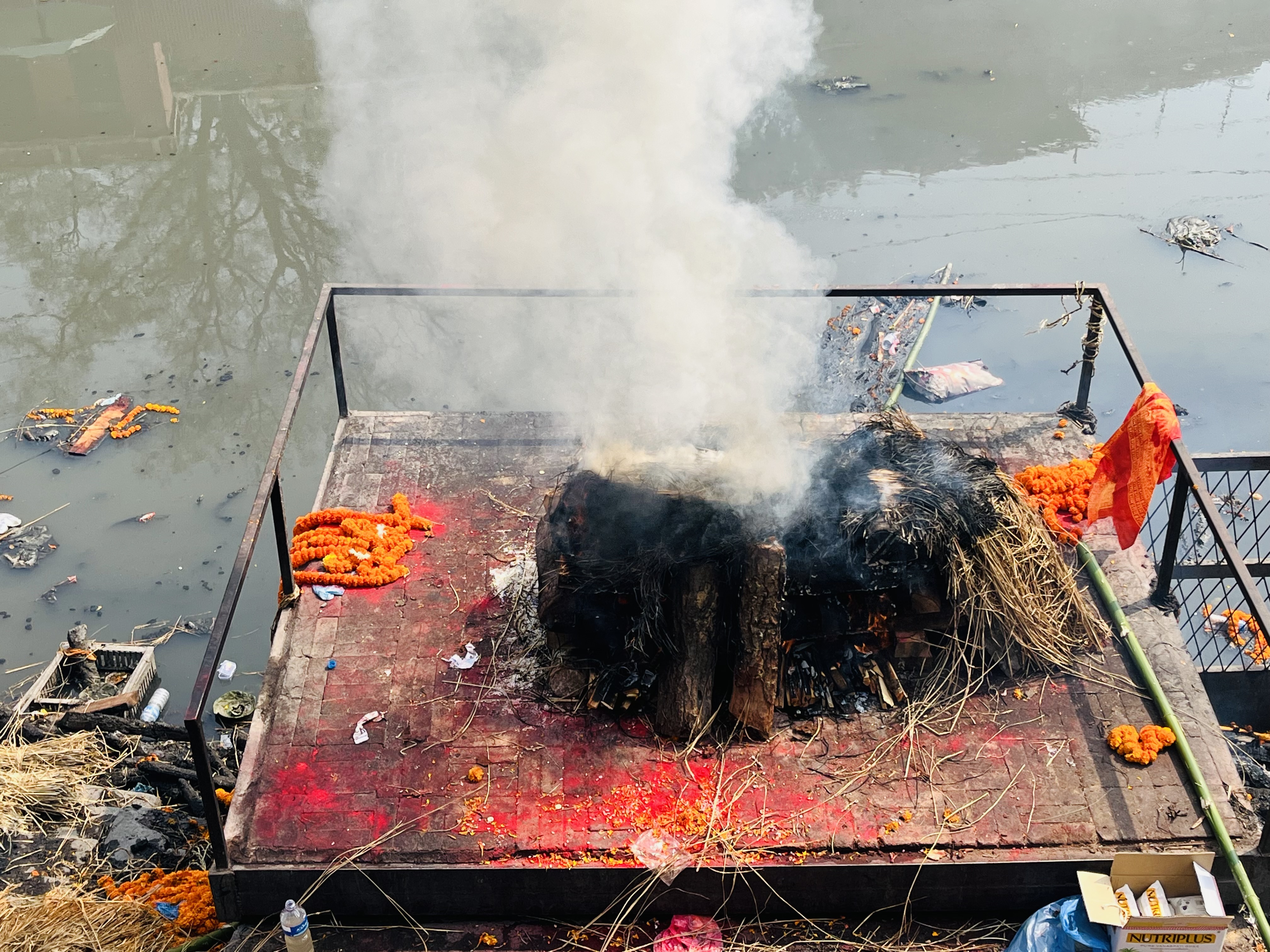
I didn’t wait for the completion of the cremation, which usually takes three or four hours. After the body is completely burned, the ashes would be scattered into the River Bagmati, which will carry the ashes to the most holy river Ganges in India. For me, the experience was peaceful and purposeful. I felt a connection with the woman who was cremated.
At sundown, I attended the temple’s prayer ceremony called “aarati” or “sandhya puja.” Cremations were still occurring in the dark on the opposite side of the bank, the fires lighting up the riverbank. The prayer ceremony was so beautiful, with chanting and fire and dancing. Everyone was made to feel welcome, the dead and the living.

 Camino Milagro
Kim, This is very interesting. I wonder what happens if the deceased is a young person or someone with a compromised life…
C
Good question — young children and babies aren’t cremated because they haven’t had time to become impure. Except for that I don’t know about the rituals.
A fascinating essay. Thank you.
Thank you!
What an interesting, informative and considerate treatise of this aspect of Hindu beliefs and practices. Thanks Kim!
Yes, very eye-opening. I had seen the cremations from a distance in Varnasi but didn’t understand their significance.
What an interesting, informative and considerate treatise of this aspect of Hindu beliefs and practices. Thanks Kim!
A celebration of one’s transition. Thanks for sharing, Kim.
Yes, we all grieve but in some cultures the rituals ease the sorrow.
Thank you for this post…. I really needed a reminder today that the world is bigger, more poetic, and colorful than the US right now.
Thank you for this post…. I really needed a reminder today that the world is bigger, more poetic, and colorful than the US right now.
Yes, and you know well how travel gives us hope in humanity.
What a trip you are having……xxx Trish
Yes, a lot of fun and learning!
Glad you got to see that, a moving ceremony. When my Indian husband’s parents died, as the eldest son, he shaved his head, out of respect. Like the man in your photo. Interesting side note: we visited Dachau, one of the Nazi death camps. It’s in the center of a little German town, and they had videos of the town folk, after the war, looking stunned and shocked at what had transpired next door to them. My husband was furious! He said, how dare they. The smell of burning human flesh is very distinctive, and they had been smelling it for years. What liars. I agreed. Why didn’t they just say they were scared, rather than pretend shock and surprise.
Wow, what a story. It seems a lot of humans are too meek to stand up for the truth.