
If Bali is the love, Nepal is the soul. Although Nepal is mostly known for the Himalayas, and as the staging area for climbing Mt. Everest, it is also a place of wonderful cultural and religious traditions, hiking, and many kinds of folk art. I was in Nepal 15 years ago with my extraordinary doctor friend, Karen Sokal Gutierrez, to help with a project that, for practically no money, eliminates pain and malnutrition in children. I wasn’t very helpful to Karen and her project, but I had a wonderful experience and I’m back to re-discover a little of this remarkable country.

As always, a little history helps with an understanding of the present. Nepal was once three kingdoms — Kathmandu, Patan and Bhaktapur — that were united in 1769 to form the modern state with its capital, Kathmandu. The united kingdom was mostly quiet until the late 20th century when a popular Maoist insurgency challenged the country’s governance. And then in 2001, the crown prince allegedly killed nine members of his family, including the king and then himself. After that, the kingdom collapsed, and in 2008 Nepal became a federal republic. Since then, communists and Maoists are mostly in control as members of parliament. Although there are plenty of criticisms of Nepal’s government, things seem to be functioning and peaceful.
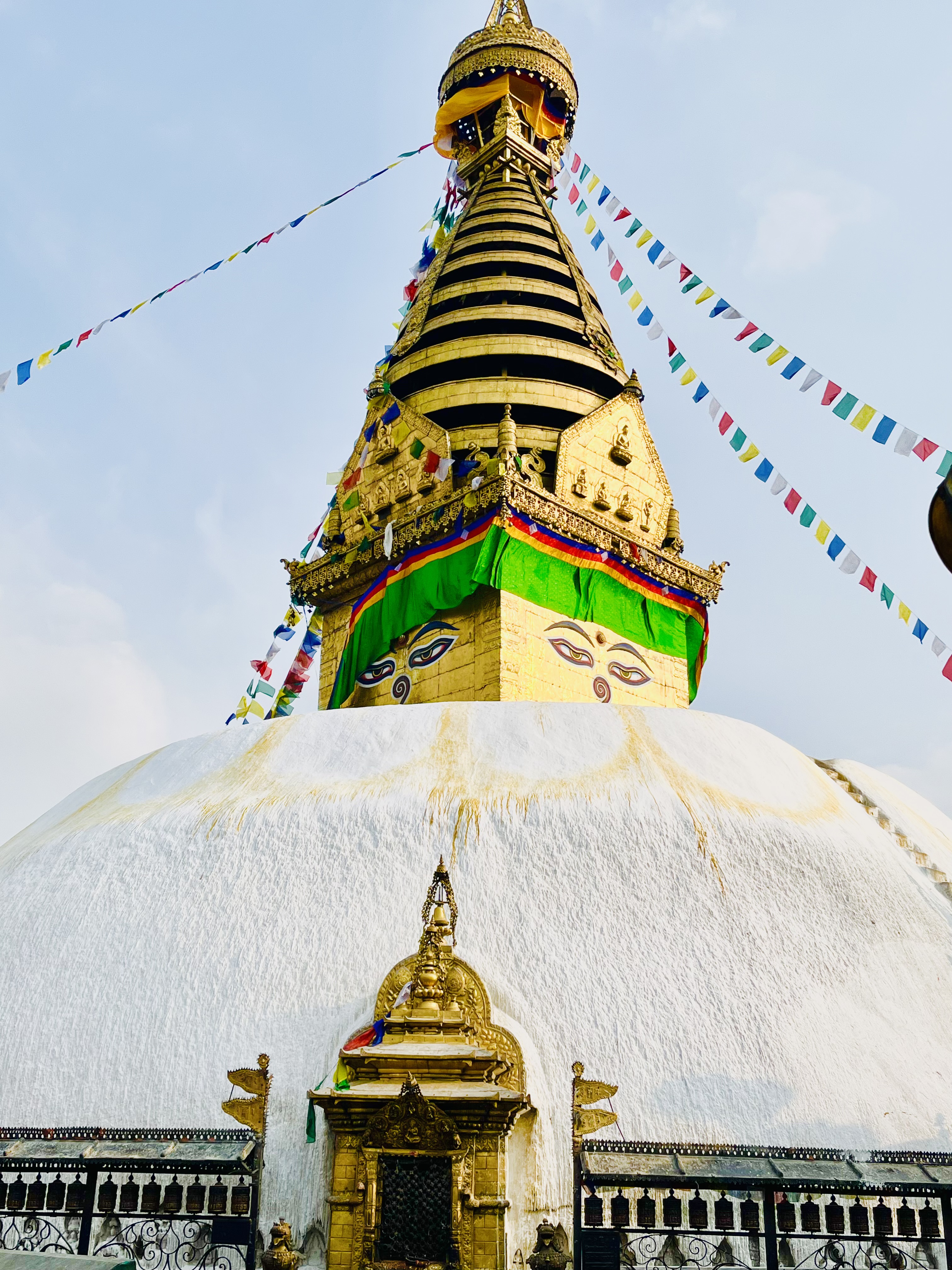
I wondered how Nepal could beat the United States and most of Europe to becoming a sovereign nation, mostly avoid wars for more than 150 years, and then quietly become a communist state. And I wonder whether it’s because, unlike most of Asia, Nepal has never been colonized, and that’s probably because it is so mountainous and doesn’t have the kind of resources invaders usually want. Whatever the reasons, its relative isolation has preserved Nepal’s indigenous cultures and their traditions. Most obvious are the ways Hinduism and Buddhism are a big part of every day life. Large and small temples are on every corner along with statues of gods, prayer flags, flower offerings, incense, and altars. If you want to see the people of Nepal — and probably some kind of ceremony — go to the plazas where the temples are, especially in the evenings.

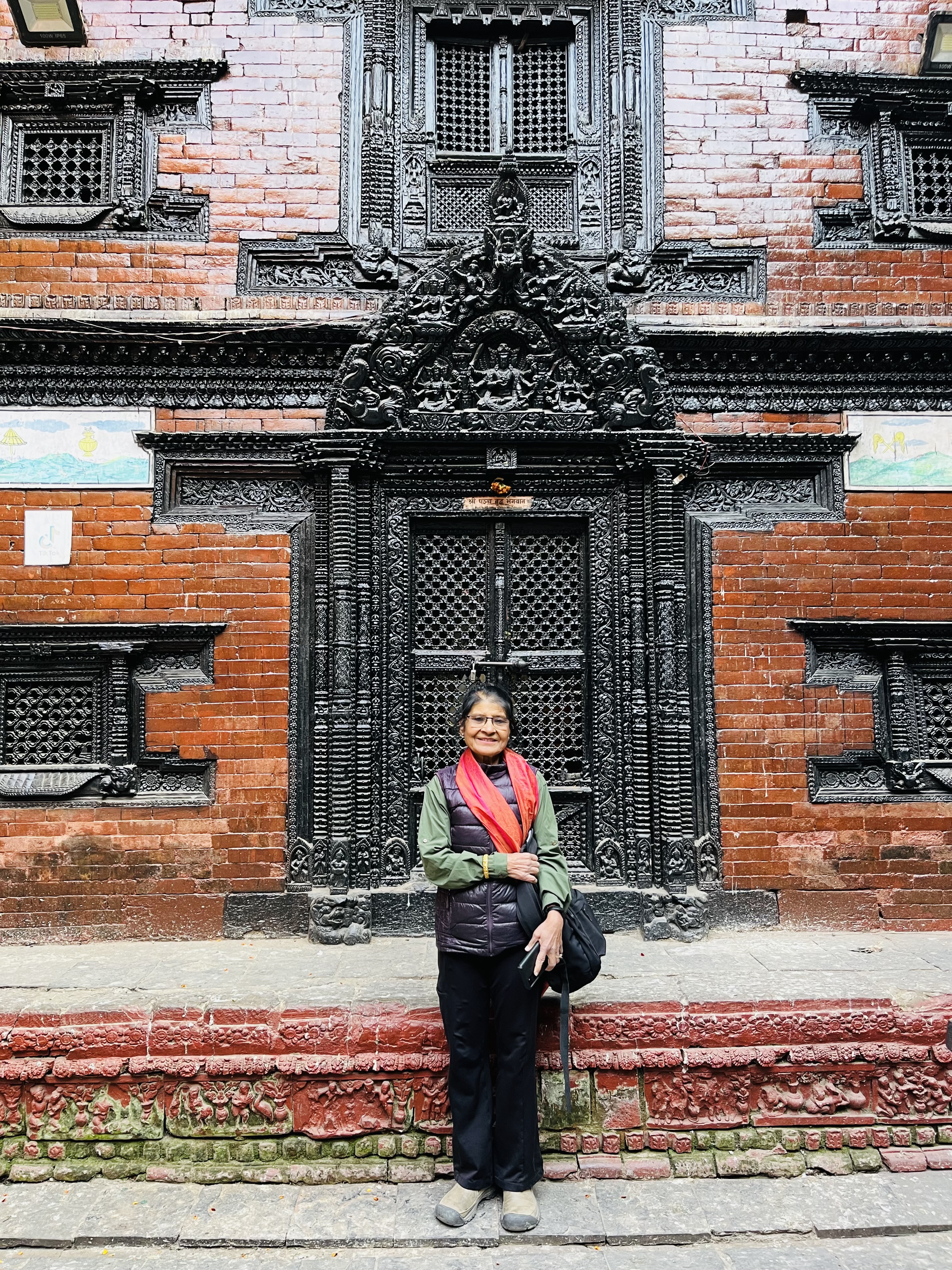
I’ve learned about some of Nepal’s religious traditions from Aparna whom I met when I was in Nepal not helping Karen. Aparna lives in Kathmandu and does a lot of public health work with women and girls in rural villages. On my first day in town, Aparna took me to Kathmandu’s Durbar Square, the city’s magnificent historic center. Most of the temples in the square are a distinct architectural style called “Newari.” The Newars have lived in Nepal since prehistory and, although their political power has declined, their traditions remain a central part of Nepali culture.

Aparna timed our visit to Durbar Square so we were able to see the Living Goddess, Kumari. The Living Goddess is an incarnation of the goddess of Taleju and the embodiment of the divine feminine. She is a real child who is chosen according to a long list of attributes — and loses her status as soon as she begins menstruating or even if she bleeds from an injury. Although the Living Goddess is a person who is pre-ordained, identifying her is a sort of competition.. It’s probably not the kind of competition that most (non-goddess) girls would hope to win. The Living Goddess cannot leave her palace and has numerous responsibilities that most children wouldn’t want. You can read more about the history of the Living Goddess here. https://heavenhimalaya.com/goddess-kumari/

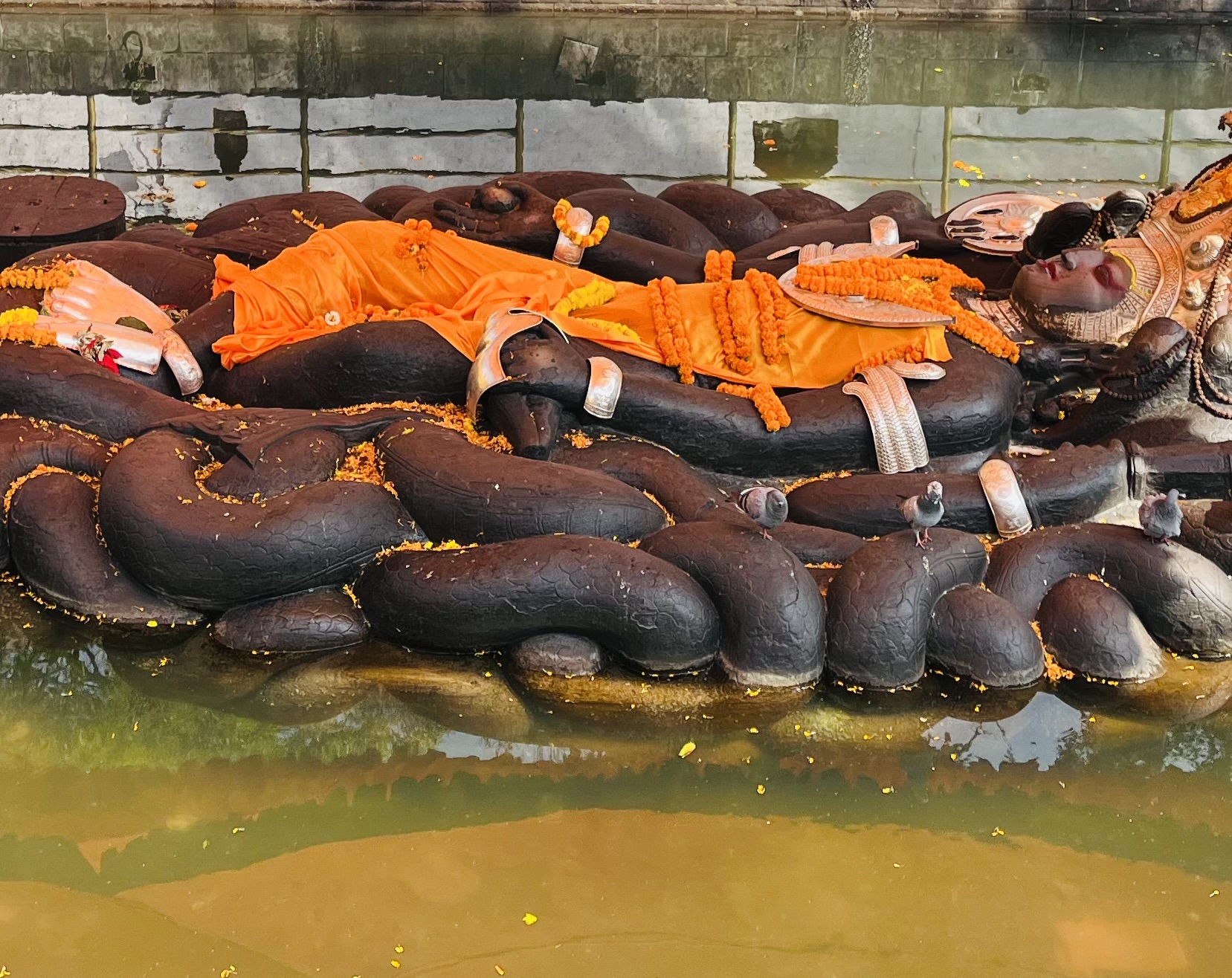
We also visited Budhanilkantha, a village just north of Kathmandu and the site of a wonderful sleeping Vishnu floating in a pond. The sleeping position represents the state of cosmic rest between creation and destruction. Found buried by a farmer cultivating his land, the statue is 15 feet long and carved from a single block of basalt. When I visited 15 years ago, the village was nearly empty except for a group of boys playing soccer with a flattened ball. (I got them a new one at a little kiosk, which they immediately sold so they could buy candy 🙂 ). This time, Budhanilkantha was busy with shoppers, pilgrims, and people just being with the Sleeping Vishnu.
The Buddhist temples here are mainly Tibetan and brightly colored. The Kopan Monastery on the hill overlooking Kathmandu trains boys to become monks, and offers classes and retreats to locals and visitors. Here, the older boys were trying to teach the younger one to play the horn called the dungchen.


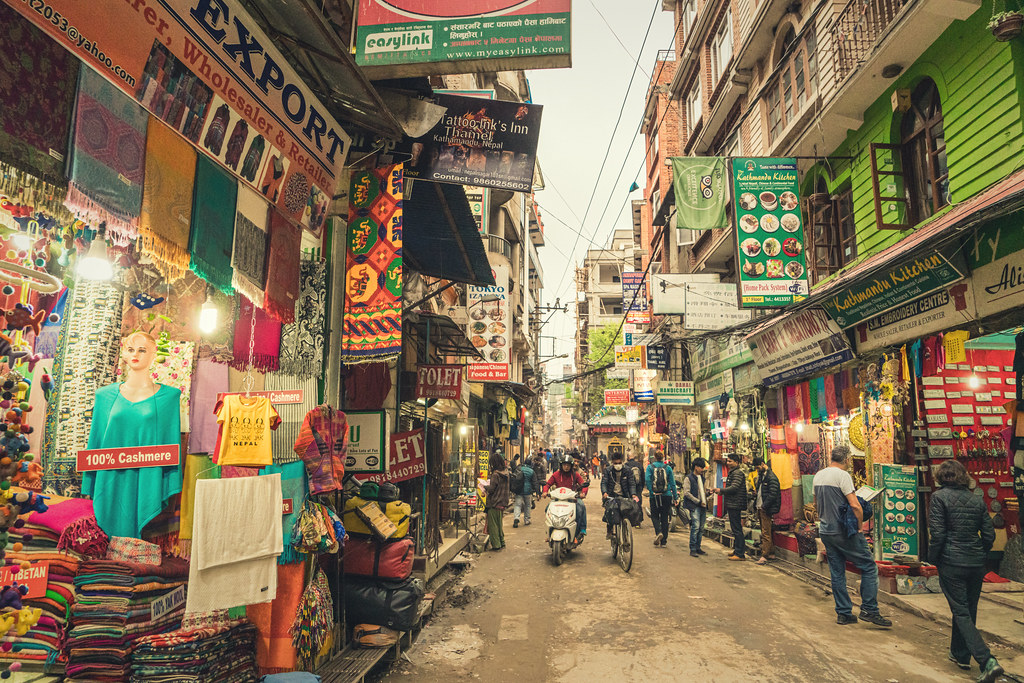
The Nepali community’s commitment to its spiritual foundations is apparent even in Kathmandu’s most commercial neighborhood, Thamel, where I stayed during my first few days in town. Thamel — loved by climbers, trekkers, and all kinds of tourists — is not one of the holiest places in town but its wall-to-wall shops have names like “Yin Yang,” “Third Eye,” and “Krishna.” They sell a lot of cashmere, knock-off climbing gear, and handcrafts, but also items for religious ceremony like incense, prayer flags, and mandalas.

And of course, Ganesh is everywhere, on walls, inside temples, at little altars on the streets, even in Thamel. His likeness is often dusted with chalk — red for passion and purity. I asked Aparna why Hindus love him so much. She said, “I think it’s because he wants us to be happy. And he has big ears and a long nose so he listens more than he speaks.”

“My religion is very simple. My religion is kindness.” Dalai Lama
 Camino Milagro
Nepal is one of my favourite places in the world. Thanks for the tour today. Maggie
“Come for the mountain, stay for the people.”
As usual, a marvelous sketch of the country and cultures, Kim! Thanks for sharing…
Thanks Fred, it’s fun to be a little nomadic again.
I’ve learned so much tagging along with you… I admit to being jealous of you (good jealousy, though…)
Thanks for sharing!
C
I’m jealous of me too — I remind myself constantly to practice gratitude
Once again I learned a lot from this post Kim… and went down several rabbit holes after I explored the link you provided for The Living Goddess which inescapably led me to others. Such a fascinating country with a unique history and people!
The pictures you shared are wonderful as always. Everyplace seems filled with color and beauty.
Your journey seems to be all you wished it to be.
If you see her, give Ella a hug from me.🥰
Yes, this time in Nepal has been full of small adventures and wonders. Seeing Ella today!
Once again I learned a lot from this post Kim… and went down several rabbit holes after I explored the link you provided for The Living Goddess which inescapably led me to others. Such a fascinating country with a unique history and people!
The pictures you shared are wonderful as always. Everyplace seems filled with color and beauty.
Your journey seems to be all you wished it to be.
If you see her, give Ella a hug from me.🥰
Ooops. I did it (duplicate posts) again by logging into Word Press as directed after writing my comment. I guess I just need to ignore that prompt although my post hadn’t appeared for 30 minutes until I completed the Word Press login.
Beautiful post! And now I’m crazing momos…. But, sadly, none to be found in SMA.
Fascinating and informative, Kym. Thanks for sharing 🙂
Thanks Rosaliene!
Kim, thanks so much for bringing me back to Nepal! I’ve also appreciated that religion/spirituality/values seem to be woven into the fabric of peoples’ daily lives. Thanks too for mentioning our child oral health and nutrition project there – you’ve been a great help. For anyone interested, here’s an article about our findings in Nepal (https://www.mdpi.com/1660-4601/16/14/2456#B4-ijerph-16-02456 ) – sadly, we’ve found the same in every country where I’ve worked in Asia and Latin America over the past 2 decades. – Karen
Kim, thanks so much for bringing me back to Nepal! I’ve also appreciated that religion/spirituality/values seem to be woven into the fabric of peoples’ daily lives. Thanks too for mentioning our child oral health and nutrition project there – you’ve been a great help. For anyone interested, here’s an article about our findings in Nepal (https://www.mdpi.com/1660-4601/16/14/2456#B4-ijerph-16-02456 ) – sadly, we’ve found the same in every country where I’ve worked in Asia and Latin America over the past 2 decades. – Karen
You have made a difference in the lives of soooo many children. Adults too! xoxox